Update

I am officially a Radford Highlander graduate with a B.S. in physics! Not only that but, I’ve already taken the chance to visit the Clemson town and campus.

Clemson is absolutely gorgeous; the campus, the people, the charm, history, surrounding area. I’m in love! I loved Radford so much too but I must say I am quite excited for the next step in my career at Clemson. I have yet to meet any faculty and other physics and astronomy graduate students but I look forward to that at orientation.

I still have so much to do to get prepared including studying my butt off! By the end of the summer, I hope to be an expert in all of the areas that I am currently weak in and then some :-). 

I have not signed up for classes yet or heard any details about my teaching assistantship training, but when I found out so will you 😉

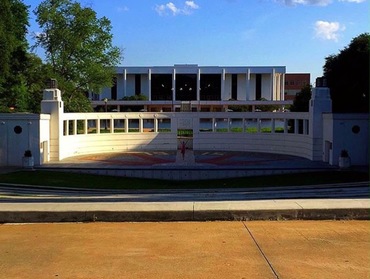
In the mean time, try to find me in the Clemson amphitheater! 

Go Tigers!

I am ecstatic to announce my acceptance into Clemson University’s astrophysics graduate program to pursue my PhD!!! I look forward to this fall to beginning a new adventure somewhere new and to keep learning and making a difference. With that being said, I think I’d like to keep my website updated on news/research/info during my stay in South Carolina. I welcome you all to follow along!

March 14, 2016

I am back in Radford, Virginia. 

On Thursday, we saw that the 1,000MHz signal did not seem to give as accurate results in the ice/water boundary as the 500MHz did. We put the Thermicrons out for two sets of temprature data. One on Thursday and one on Friday.

Thursday, we managed to get most tasks done around a big gap of the day where we were suspended off the ice due to polar bears having wandered far inland. It took the townsfolk all day to watch the bears travel back up North a safe distance. We got some OhmMapper data using a different technique than usual, a dipole-dipole expanding array. It takes a vertical sweep of the ground instead of its usual horizontal sweep and map of the subsurface. We then drilled into the ice in order to compare the data. Our hopes are to graph the resistivity data and find a break in the line that will represent the ice/water boundary.

We did this Thursday and found promising results so we decided to try again Friday. It seems to be holding consistent and giving us measurements of the thickness of about .95m compared to the ice drill data that showed .93 meter thickness. This is looking up!

Friday, we did a 900 meter run out onto the ice during the time satellites went over to get the same data so we can ground truth for them. We took the GPR and the microclimate sensor sled as well as one sled that only took surface temperature data.  

The data seems to be holding up the possible correlation of the surface temperature of the ice and its thickness. We are still in the preliminary stages of processing data, however. 

We presented our preliminary findings at the local library for a few locals and local scientists. I think it went well! It will be good practice for the Student Engagement Forum at the university in April. I am excited to get to work and get a better sense of what all of this data is telling us!

March 10, 2016

​Yesterday we scheduled to go to the NOAA facilities and the Inupiat Heritage Center to tourist up the place while we are able to. Of course though the day we plan to do all of the fun things the weather clears up – perfect conditions to go out on the ice.

So we had to improvise our day plans. For a couple of hours we toured the NOAA facility thanks to our friend Bryan Thomas who recently started working with the NOAA. They primarily monitor greenhouse gas concentrations in the atmosphere because the Arctic has some of the less polluted air so it is easier to pick out tiny signals from pollutants. They let us take home a can of sample air! Ha! The March 9th CO2 concentrations were 409.49ppm. 

Then we quickly got together to get on the ice. We got Sleds A (with the microclimate sensors) and C (just IR) out on the ice and surveyed a 400 meter line perpendicular to shore. We later found out Sled A wasn’t marking data to keep track of distance and four of the sensors (out of 6) were acting up. May have to replace those temperature sensors and rewire the distance tracker. Sled C was good data. 

We got Hans strapped in the OhmMapper. We aren’t sure if the signal being lost with the OhmMapper is due to the water eating the signal or the cold getting to the receivers and transmitters so we decided to try to control for one (coldness) to see if we can get better data. We kept the OhmMapper warm inside the van and pulled up right to the shore and assemble the receivers and transmitter. We waited until we got out to the 200 meter mark to start collecting data, all the while keeping the receivers and transmitter off the ice until we were ready to start data collection. We were able to get data up until about 190 meters down the line. I have yet to look at the modeling status of the data but we were able to get all four receiver data for 190/200 meter line so that is looking up! 

We also got the GPR out there to feed/receive 500MHz. We did look at the picture GPR mapped and it was a consistent 80-90cm boundary of ice-water. Which is exactly the measurements we got ground truthing last week with the ice drill. The ice is much thinner than in 2014, so the variation of ice formation is less – i.e. the ice is much smoother on the bottom. 

It was a successful day out on the ice and we ended it with the Inupiat Heritage Center and a dinner out in the town. Not to mention at midnight last night, Katie woke us all up to catch the most beautiful, breath taking, vibrant green aurora I have witnessed. It’s the brightest we’ve ever seen. It was gorgeous. We managed to get a group exposure photo. So excited to see how it turned out! 

Today, we are going to take the GPR out again but with the 1,000MHz transmitters and hopefully get the Thermicrons (temperature probes) out on the ice and see what we get. Probably going to do some data processing and maybe take OhmMy back out. Oh, also we need to prepare for Saturday’s Tuzzy talk with the towns folk and other visiting scientists. These next few days will be jam packed!!

March 8, 2016

The weather has stayed a consistent windy and cold. Since I got off the plane it’s been at least -30F with gusts of wind reaching 35mph. Again, it was too cold to get out on the ice with the equipment. Not only was it too cold, but the wind has been so strong that it’s blowing the snow around to create a fog that limits visibility to about a mile. That creates unsafe conditions in regards to watching out for polar bears on the ice. We managed to get some data however to test the capabilities of OhmMy. Unless it clears up a reasonable time before sunset, it looks like that is all we will be able to do. 

We’ve had some issues with the odometer wheels. One of the Hall sensors totally defected and others had to be re-aligned as well as readjusting one of the Dallas Semiconductor temperature sensors. That only took a small portion out of our morning, though.

In the meantime, the research team has gotten lots of opportunities to get to know one another and bond. Maybe it will be better this way to gain camaraderie now and be an even better team once we are able to start getting data on the ice. I am hopeful to have the data and team ready to go the first chance we get to go out there. Wish us luck!