Is science an attack on religion?
Short answer: No. Science is not an attack on religion.
For this post, you are going to hear a lot about
Carl Sagan. He was a brilliant astrophysicist who had a way with connecting the public to science.
Neil deGrasse Tyson was taught by Carl Sagan. The movie
Contact (that has
major religious undertones!) with Jodie Foster and Matthew McConaughey is based on Carl Sagan’s book
Contact. He wrote several other books including
The Variety of Scientific Experience which focuses on the two topics and how they relate: science and religion. I recommend reading this book if you are interested in a different perspective on how to embrace
both. This is not a celebration of my faith or anyone else’s. This is an essay discussing a different outlook on science and religion than what we popularly know of. Carl Sagan was one of the American scientists to really capture the beauty and human empowerment that we can achieve if we can learn to embrace both science and religion together.
Science is not an attack on religion. I’m going to make some hard-to-swallow statements:The Big Bang theory (not the show) does not suggest there is no God.
The evolutionary theory does not suggest there is no God.
After all, Pope Francis himself suggests these theories don’t prove there is no God but rather that these theories require that there be one. I think that is a very powerful thought. These theories are still being developed, too. This isn’t the final hour but rather just the best guess we humans have at understanding what we have observed. What we provide in these frameworks is what is consistent with what we know and what we observe – there is always room for improvement and even change.
Science is the pursuit of knowledge and truth. It seeks to understand the world around us. For many individual scientists, their pursuit is inspired by their desire to get closer to God and to understand the Heavens. For some it is a quest to understand God’s existence. For others it is a journey of fulfillment; seeking to understand everything they sense, regardless of what religious realms they might uncover.
Scientists often feel a deep connection with science. We may even describe it as a religious experience.
The term [‘God’] means a lot of different things in a lot of different religions. […] To others, for example, Baruch, Spinoza, and Albert Einstein, God is essentially the sum total of the physical laws which describe the universe.
— Carl Sagan
It would be fair to point out that some scientists may even interpret the laws of nature being either the consequence of the existence of a God (i.e. gravity belongs as a inner working to a God) or as the essence of their God (i.e. their God’s powers emerge in the form of nature’s laws).
I would agree that it would be too soon to mark all scientists as athiests. Scientists tend to have minds that are swayed when presented with empirical evidence.
No decent scientist will try to convince you there is no God.
Because we simply do not know enough about the Universe to make such a statement!
If we say “God” made the universe, then surely the next question is, “Who made God?” If we say “God” was always here, why not say the universe was always here? If we say that the question “Where did God come from?” is too tough for us poor mortals to understand, then why not say that the question of, “Where did the universe come from?” is too tough for us mortals?
— Carl Sagan
|
|
But in order to be able to embrace both religion and science, we have to be open to learning new information and most importantly, we need to be comfortable not having all of the answers.
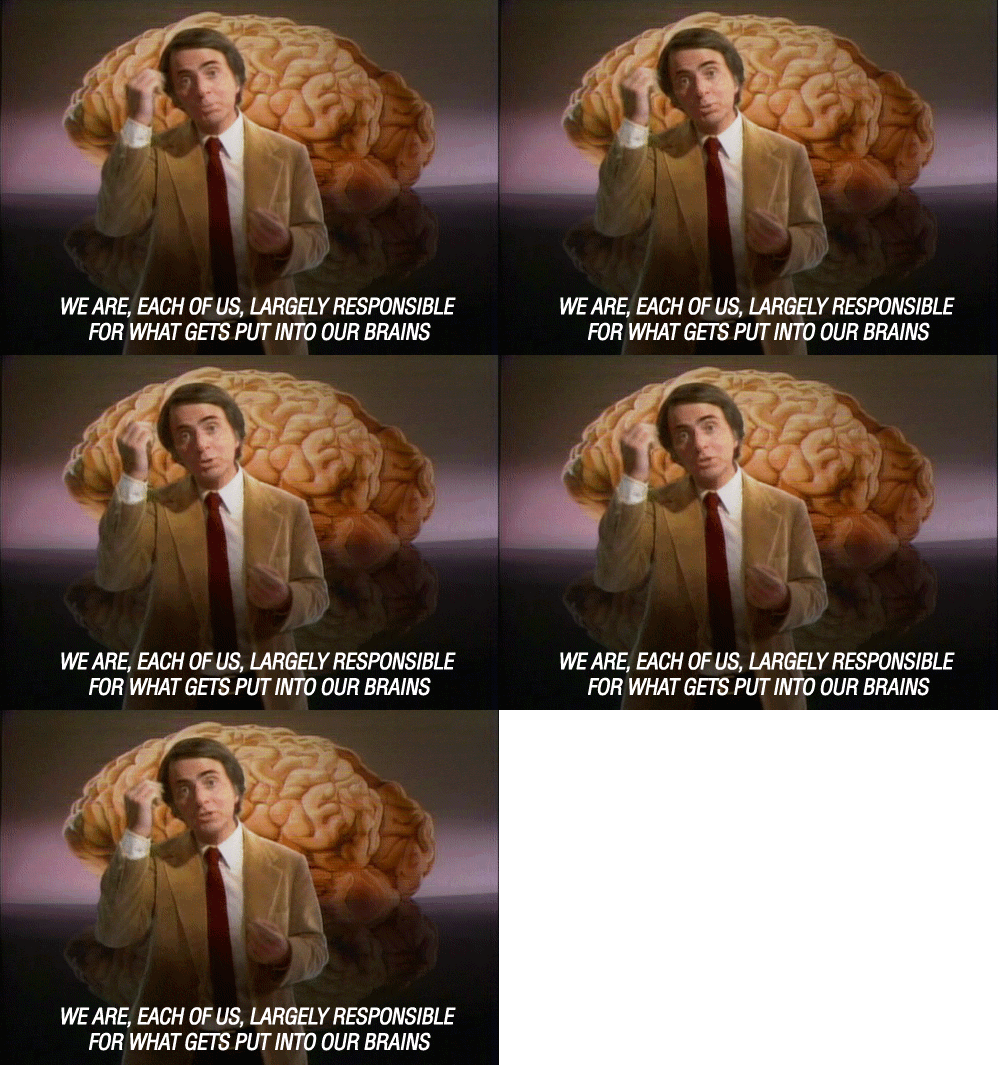
We are only human. We do not know anywhere CLOSE to everything there is to know. We may never know it all….
|
I am extremely uncomfortable with dogmatic atheists, who claim there can be no God; to my knowledge, there is no strong evidence for that position. I’m also uncomfortable with dogmatic believers; to my knowledge, they don’t have any strong evidence either. If we don’t know the answer, why are we under so much pressure to make up our minds, to declare our allegiance to one hypothesis or the other?
–Carl Sagan
For some of you, faith is all you need and I think that is beautiful. You are someone who is so loyal and confident to your God and your God is lucky to have someone like you on their side because you show strength and power. However, I urge you to always remind yourself of the extent of what you put your faith into. Let’s not forget that the Bible was written a very long time ago. It was written and edited hundreds of time since its creation. There are some things we have gotten wrong in it. Just like how scientists have gotten many things wrong before, too.
Remember when we found Pluto and we thought it was ten times the mass of the Earth? Today we understand it to be 0.2% of the Earth’s mass! And remember when we thought that because the Earth is made of dirt and rocks, that the stars had to be made of it, too? Today we understand that stars are hot balls of hydrogen and helium! Remember when we tried to measure the speed of light by taking lanterns on top of mountaintops and trying to time the on/off of the lights? Haha! Today we understand that light can travel the Earth’s surface in seven seconds! Remember when we legitimately thought the Moon had intelligent alien life on it? And then Mars? I mean really. Very distinguished and beloved scientists believed plenty of outlandish things. Not to mention we have used science for really, incredibly inhumane things (ahem, nuclear weapons, biological warfare, etc.).
Science is not perfect. A decent person won’t tell you that science has it all figured out and that religion has it all wrong. Though we have presented evidence over time that says, “Hey, you know how we’ve been interpreting the Earth as being merely a few thousand years old? Well we just found evidence [tons of it] that suggests it is much more exciting and dynamic than we thought!”
This evidence in no way suggests there is no God. It just means we are learning about our world. We are learning that we are only human and therefore, we do not hold all of the answers. If you want to think of it this way, God has given us clues along the way to help us grow closer to him. He has given us this information. He is helping us understand our own, collective purpose. Sometimes he even does things to save us from ourselves.
He can manifest himself as laws of nature. He can manifest himself as the Big Bang that led to the existence of this Universe. He can be the divine intervention in the evolutionary theory that ignites genetic mutation. He can be all of these things.
Science doesn’t say He can’t be a part of this newfound evidence.
My guess is that there has to be some deeper explanation. But that doesn’t mean the explanation has to be what the people themselves report—that they went to heaven and saw a god or gods.
–Carl Sagan
Do you agree that worshipping can be different for everyone? Do you agree that branches of christianity stem from varying interpretations of statements in the bible? This is the same thing. Science and religion are not mutually exclusive pools of thought and the two topics have quite a lot they could learn from each other.
For one, religion can provide science a deeper meaning in research endeavors. Human values and scientific goals should be at the forefront of any endeavor, and never with malice.
|
|
Science has something to share with religion in how to interpret evidence and seeing beyond the surface, revealing the inner workings of life itself, its beauty, and what it has to offer us. Science can help awaken our religious experience as we walk through life.
This is a learning moment for us all. Not one of us has all of the answers. We are simply all searching for the answers in different ways.
Merging science and religion can be a powerful, unstoppable force. But currently the two are at odds globally, which can have devastating consequences. Over human history, religious conflict has killed so many and scientific advancements have been taken advantage of costing the lives of many more.
This is not necessary.
It is not the teachings of any God and it is written nowhere in the scientific method. Moving forward, let’s be mindful of our experiences and the information we absorb. Whether you are a religious scientist or a religious science skeptic, keep these things in mind to help yourself (and others) to grow their relationship between science and religion:
1. There are many real mysteries that not even science can explain. Go deeper. Keep asking questions. But most importantly, be okay with not having an explanation. Do not invent explanations that have no support.
|
|
Imagine our ancestors looking at the moon, the planets, the stars and making up stories to answer their need to understand. In many cases, the stories involved deities, such as the moon as a god. Now is that myth about the moon deeper because it was wrong? Should we waffle, and say, “Well, if we can redefine what we mean by a god, then we can still call the moon a god?” No. Let’s admit that the moon is not a god and move on. It seems to me that it is a much greater achievement to understand what the moon is really about—4½ billion years old, cratered by enormous explosions in its earliest history, a desolate world on which life never arose.
–Carl Sagan
|
2. Be kind to others even when they don’t think like you.
3. Be skeptical. Ask for verification (constantly!).
If someone claims a thing happens in a certain way, you do the experiment to check it out, to see if, in fact, it works as claimed. You examine the internal coherence of the idea. You test its logical structure. You see how well it agrees with other things which are reliably known. And only then do you start accepting new ideas.
–Carl Sagan
4. Be more open to science and religion. After all, just look at all the advancement we have made in science. We have extended life expectancies, developed life saving equipment for thousands of medical conditions, developed communication that has made the entire globe more connected than ever before, we have sent humans not only into space but on the moon for Christ’s sake ;-). Religion has brought us a deep sense of purpose, community, and morality. We are in touch with what is right and wrong. We discuss what is right and wrong and how to establish moral code all of the time. We grow as a species in both respects because of this.
In short, pursue truth while practicing love.
My deeply held belief is that if a god of anything like the traditional sort exists, our curiosity and intelligence are provided by such a god. We would be unappreciative of those gifts (as well as unable to take such a course of action) if we suppressed our passion to explore the universe and ourselves. On the other hand, if such a traditional god does not exist, our curiosity and our intelligence are the essential tools for managing our survival. In either case, the enterprise of knowledge is consistent with both science and religion, and is essential for the welfare of our species.
–Carl Sagan











 in units of ergs/cm
  /s. This is the spectral flux density in units of energy per area per second. But why
  ? What does that even mean to us? How does it relate to the total flux from a source at a given frequency? And what are the perks to defining and plotting the spectral flux density?
 is useful and why that is so.
  (or nu, a greek letter), and wavelength,
  (or lambda, another greek letter):

![F_\nu = I_\nu Cos[\theta] d\theta d\phi](https://s0.wp.com/latex.php?latex=F_%5Cnu+%3D+I_%5Cnu+Cos%5B%5Ctheta%5D+d%5Ctheta+d%5Cphi+&bg=ffffff&fg=393939&s=0&c=20201002)
 /s is
/s is
 (the net flux over a given frequency) against the frequency and integrate the area under the subsequent data (see the figure below), you simply get back the total flux in that range. That’s really it. There’s no safe way to guess how much of say, the X-ray flux, compares to the gamma-ray flux just by plotting it this way. You’d have to sit down and do the math using the equations above.






 )
)

![d Log[\nu]= \frac{d\nu}{\nu}](https://s0.wp.com/latex.php?latex=d+Log%5B%5Cnu%5D%3D+%5Cfrac%7Bd%5Cnu%7D%7B%5Cnu%7D+&bg=ffffff&fg=393939&s=0&c=20201002)

 ,
,  , and
, and ![x=Log[\nu]](https://s0.wp.com/latex.php?latex=x%3DLog%5B%5Cnu%5D&bg=ffffff&fg=393939&s=0&c=20201002) .
.
 versus the
 ![Log[\nu]](https://s0.wp.com/latex.php?latex=Log%5B%5Cnu%5D&bg=ffffff&fg=393939&s=0&c=20201002) and get a lot more information (over a wider range of frequencies!). There are a lot of special things about this trick but the main one I want to emphasize is that plotting this way, we can see where the total flux is being dominated. Look at the example of another spectral energy distribution (SED) shown below.
and get a lot more information (over a wider range of frequencies!). There are a lot of special things about this trick but the main one I want to emphasize is that plotting this way, we can see where the total flux is being dominated. Look at the example of another spectral energy distribution (SED) shown below.
 enables us to immediately understand what part of the electromagnetic spectrum being generated from some source is dominating the observed flux. i.e. how bright is it in one energy range from another?

 is the photons per area per second, thus
  is the change with energy, and E and
  are related. I’ll leave this up to you to ponder (and the pdf linked at the beginning has some extra insight to this!)
 to more than
  ergs/cm
 MeV. That’s EIGHT orders of magnitude!

 JORDAN L. EAGLE