Pulsars and Pulsar Wind Nebulae

Hey guys! I thought a good first blog post would be one to get you familiar with the objects I’ll be studying at the CfA. Good, I’m glad you like where I’m going with this. Let’s get started!

The articles I am using to help frame this post can be found here:

Pulsars and pulsars wind nebulae (PWNe) all start with a common origin: the death of a star. A really, really massive one. Like, tens times the mass of the Sun. When these massive stars reach the end stages of their life (1),  they collapse in on themselves, giving into their own gravitational force. A violent shock wave forms and rebounds off of the core of the star, ejecting star matter with it at thousands of kilometers per second through space (something like 2 million miles per hour). This shock wave hurls stellar mass with it and sweeps up surrounding material that falls in its path. Famous examples of core collapse (CC) supernovae include the Crab nebula, the Vela complex (the closest to Earth), and Cassiopeia A.

At the same time the shock wave is propagating out from the surface of the star, what is left behind is the neutron rich core called a neutron star. Neutron stars are iinnncredddibblllyyyy dense. We are talking the size of one to several suns packed into a ball no larger than, say, the size of Manhattan. NO I’M NOT KIDDING. Not only are they dense af but they also rotate rapidly, sometimes as fast as 40 milliseconds or less. Are you hearing me? 40 milliseconds = 0.04 seconds! It’s rotating one full revolution in that teeny tiny amount of time!

I’M NOT EVEN DONE YET. These neutron stars come with swole magnetic fields. I mean seriously strong magnetic fields. So you have this dense, small, fiercely rotating ball of fire with strong magnetic field lines stretching through the space around it. All of this can cause particles from the neutron star to leave the star and travel deliriously through the magnetic field. These particles have enormous amounts of energy and get entangled with the star’s massive magnetic field as it rotates. As a result, a stream of particles juts out from the neutron star’s poles generating a stream of energetic particles that are wildly interlaced in the star’s magnetic field, generating all kinds of radiation across the electromagnetic spectrum (i.e. light, and all kinds, too!). We call these types of stars “pulsars” because they generate pulses of light with those jets of particles and are detected right here on Earth. The pulsation is VERY regular. It’s SO regular, that when they first discovered pulsars, they named them LGM: little green men. I’m not kidding!! Jocylen Bell Burnell and her supervisor, while she was in graduate school, first discovered these insanely periodic beasts. I believe her advisor got the Noble Prize for discovering pulsars later on.

Picture

A core collapse (CC) supernova explosion sends out a violent shock wave in all directions and leaves behind a spastic neutron star.
Picture

As the neutron star rotates, it fuels powerful jets that are seen at either pole. Subsequently, the star beams very regular pulses of light directed towardly Earth.
​So anyways, those little monsters are cool for their own reasons but they’re not really my focus. My focus are the winds they power. Yeah, more power!

​Remember those particles we were talking about that get stripped from the neutron star? Some escape the poles and make it in another confined region around the pulsar. They are still wildly interacting with the magnetic field though. Most of these particles are electrons and positrons, by the way (like you were wondering, haha, right?). These are charged particles, accelerating in the magnetic field and are very energetic out here, like – relativistic. That means these little particles are traveling close to the speed of light! Often these particles are so energetic, they radiate from radio to X-ray and even gamma-ray! These particles are confined within the pulsar’s magnetic field and generate a massive, powerful wind bubble around the star. This, my friends, is a pulsar wind nebula.

Picture

The light spectrum! Review for some of you. Gamma-rays are the highest energy light waves.
Picture

Vela pulsar. Pictured here is well within the pulsar wind nebula, Vela-X. Vela is so powerful, it generates powerful substructures within the wind. You can see here radiating toroidal arcs, or bow shocks, that give us a good idea the direction of the pulsar’s proper motion. You can also see the powerful jet. It looks like smoke coming from the bow shocks. The twirling of the jet is actual evidence that the pulsar PRECESSES!!
Picture

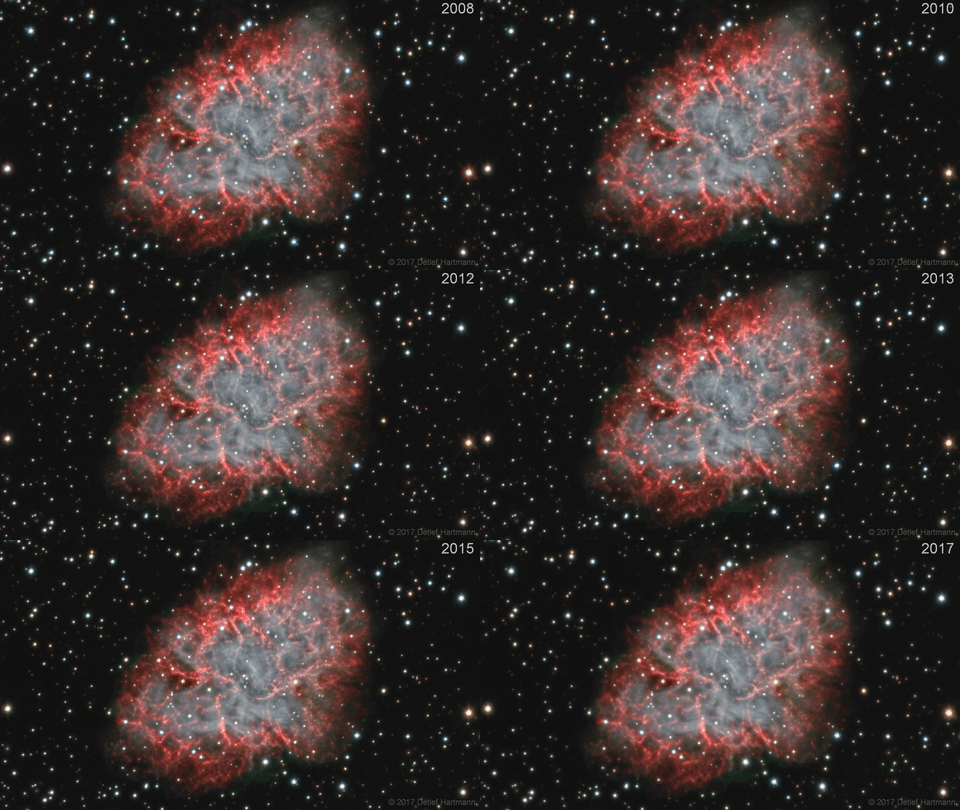
Crab Nebula: 2 kiloparsecs away from Earth (3.835e+16 miles!), rotates once every 30.2 milliseconds (ms). This is what is left behind from a supernova explosion that occurred about 1,000 years ago. (By the way, this is a real decade long time lapse, see links below).
For more information on precession, click here.

​The two pulsars above are famous examples of pulsars currently fueling a pulsar wind nebula. There is tons of literature on both of these objects 1) because the Vela pulsar is part of the closest known composite supernova remnant to Earth and 2) the Crab nebula is believed to have been observed from Earth in 1054AD. Below are some great links to learn more about these systems!

The Vela Complex:

The Crab Nebula:

Part I: Contact

First of all,

Greatest movie, book, author, and astronomer of all time. Contact by Carl Sagan. My dad and I watched that movie together a lot growing up. On top of that, Dad always had a telescope of some kind. We would look at planets, stars, the moon, whatever was out. If I’m being honest, Dad was the big nerd that made me the nerd I am. But really, these two things are what sparked my interest in those little points of light in the night sky. I idolized Ellie Arroway (main character in Contact) growing up. I wanted to be smart! I wanted to be that girl that had a book for every occasion: a “bus” book, a “lunch break” book, a “theater class” book, you know, like Rory Gilmore. I loved Rory Gilmore in Girlmore Girls, too. It’s a TV series following a girl beginning in high school named Rory. Rory is such a strong, smart girl driven to go to Harvard and her mother is very eccentric and quirky. I loved it. I wanted to be like that. And yes, I am embarrassed to say that I got all my inspo from TV and movies. But hey, I could spin this around to say something like: See? Even I didn’t know reality yet. It’s not like I was solving equations since I could talk or anything.  In fact, math and science turned out to be a pretty big struggle for me in elementary school and that persisted into high school.

DSC_0203

This was in Harder Klum overlooking Gindelwald. We visited several cities in Switzerland including Grindelwald, Spiez, and Interlaken. All equally stunning in beauty and nature.
received_2263806920548133
Spiez, Switzerland (ft. Spiez Castle) 🏰
The great Kirsten and Jacob Ruth! Belgium has been good to you but we are excited to have you back in the states soon!
This concludes Part I but, on another note: Look at Switzerland! I visited some friends this past summer (Jacob and Kirsten) and we explored Europe together. It was me and Noah’s first time traveling out of the country. It was absolutely lovely. Hey! This gives me a great idea for another post.

Bringing in the new year with a BANG

First things first: This video is old but I’ve never thought to share it and it’s a great video showcasing the Clemson University Planetarium featuring myself and my old boss: ​video here.

Secondly, my paper was accepted and published in January of this year to the Astrophysical Journal! If you have a membership you can view it here (student/institutional staff usually have memberships through the university): for IOPScience click here. If you are not a student or are not affiliated with any academic institution try ArXiv here. And if that doesn’t work, you can try directly accessing the pdf here.

If you’ve exhausted all three options to no avail and really want to read it, please contact me directly and I would be happy to send the pdf via email. 

Lastly, I took my last written qualifier today. If I pass, I will be clear to move on and continue full time with my PhD research. If I fail, I will not be pursuing a PhD and can only graduate here with a Master’s (lol, “only” – a Master’s is still an amazing accomplishment!). I find out the results next week if I passed or not. It’s going to be a looooooOOOOOOOOooooong week. 

In short, it’s been a great start to the new year for me and I hope 2019 keeps on givin’. Shortly, I will begin another stage of my research and will share it all with you as we progress. 

Best Moments of 2018:

  • Finishing up the two years of full time coursework at Clemson University before fully concentrating on research
  • Passing 2/3 written qualifiers on the first go around, having only one to worry about up until today.
  • Submitting my first research paper as first author and getting it accepted with very minor revisions required before publication
  • Traveling with my partner, Noah. From Colorado, Georgia, and Virginia to Nevada and Europe in 2019! 
  • Taking time for myself, even when I felt like I needed to work until my hands fell off for the success I wanted so badly
  • Dog sitting in free time – so many doggos in life and they’ve all been amazing! It’s also been great adding new regulars to the schedule
  • Running the planetarium, as always. 
  • Meeting my little nephew for the first time and seeing my devil of a sister be a wonderful mother.
  • Having a great dog and cat and roommate and partner (and cheers to years to come!)

Goals for 2019:

  • Pass the last qualifier that I took today and get started with the rest of my research projects
  • Travel to Europe with Noah
  • Attend the Supernova Remnants II Conference in Crete, Greece in June
  • Get another paper ready for publication
  • Graduate in Spring 2019 with Master’s (en route to PhD)
  • Stop complaining
  • Be more kind
  • Do more outreach

“There are more things in heaven and earth, Horatio, than are dreamt of in your philosophy”

We have reached an interesting crossroads. One path, the one we are on, further disconnects the scientific community and the general public. This path includes future dangers like eradicated diseases re-surfacing, disregard of ecosystems, widespread famine… The other path promises prosperity, a deep connection, understanding, and appreciation that is shared among scientists and civilians alike. What scientists do in the coming decades will determine what path we will choose. It seems obvious which path we should choose and I’m going to put the responsibility on the scientists because we have clearly dismissed the inquiries of the general public and now they are making their own terrible decisions on things we could have discussed with them a long time ago (ahem – the rising vaccination concern). Now I know that there are other factors influencing people to misinterpret scientific claims (i.e. Jenny McCarthy’s *medical* opinion on vaccinations, President Trump’s claim that climate change is a hoax, etc.) but the leading scientists in these fields know more about these issues than anyone and it is imperative (and a growing requirement for the future welfare of the planet) for scientists to stop ignoring the anti-vaxxers and the creationists and instead start engaging. I know this is a tumultuous and exhaustive effort. It is going to take everything we have. But humankind is counting on it. Otherwise, we will be our own demise.

The first vision I will share with you will be the effort as an astrophysicist to communicate often with the general public. Ways I currently do this include the Clemson University planetarium. The shows are open to the public and are available upon request, free of charge. We accept requests of many topics. At one point in my time as a planetarium operator, I gave a show to a private (religious) elementary academy that teach their children creationism – that the Earth is merely 4,000-5,000 years old. They specifically requested that I not mention things that conflict with their curriculum. Upon this request, of course, we all scoffed. And then, no one bit. No one wanted to take the show. I even wanted to be dishonest to my commitment as an educator and take the moment to tell the kids that everyone in their life is in denial and that I have all the answers. But I realized this will do nothing but create animosity in the kids towards scientists. Surely, they are much too young to fully comprehend their curriculum or even the rest of the world’s for that matter. Make no mistake, I will not lie and create a show to their liking and their beliefs. What I decided to do instead, is give the children a planetarium show just like like I would any other group. I talked about the constellations and their meanings, the planets and their atmospheres, how the Moon stabilizes the Earth’s wobble on its axis, and we flew out of the galaxy and saw everything we know about in our galaxy like pulsars, supernova remnants, gas clouds, nebulae, and more. I want the children to know this stuff exists. I want them to think for themselves. To wonder. To ponder. To pursue. I want them to not be punished for their parents’ actions. They deserved a planetarium show like anyone else. Just because all of the adults in their lives are (very much so) disadvantaging their children, it is not the child’s fault. And what I can do, as a science enthusiast, is give them the tools. Let their gears begin to turn. And hope as they grow older, they think for themselves. 

Because what late Bill Nye and Neil DeGrasse Tyson have taught me is that people who do not understand do not respond to condescending reactions. You can cause more damage making someone feel dumb rather than just engaging. And if you’re really good at it, you can share your interests (and scientific facts) without them quite knowing it that will stay with this person. It will fester and grow on its own. Patience. That is my first vision: bridging the gap between the scientific community and the general public; opening up the conversation to include civilians. Ask me what I do and why I do it and how I learned it. I want you to understand, too.

My second vision will be addressing underrepresented groups in STEM. I want to use my position in STEM and public and educational outreach to serve as a role model for other women and I want to reach out and work alongside with other disenfranchised groups so they know they have my support and that the global support is growing. To do this, I want to become an influential figure who is open and honest. I will do this through my academic success and growth/development in my field by traveling to conferences and giving talks and serving on student panels, sharing my challenges, fears, goals, hopes, dreams, with anyone who will listen. I want to share my experiences with those who can understand that it doesn’t matter who you are – you are human: you experience failure, you experience embarrassment, but that you should overcome all of that for the g o o d stuff. And many times, it’s easier said than done. Which is why outreach is so, so important. Providing support groups, clubs, and events, where underrepresented groups can come together and not be alone in their struggles and where well-represented groups can come and learn how they can be more inclusive. Workshops and social gatherings focused on these issues will be essential in a global conversation in equalizing the playing field in STEM.

These are some serious tasks and I cannot do it alone. I am applying for the Toptal scholarship this spring (2019) in hopes of gaining the support and mentorship to face these problems head-on. Hopefully, I will be able to reach a wider audience with my message, my research, my advice, support and comfort to other underrepresented groups. Through it all, we need to remember, scientist or not – we are in this together. We’re stuck on Planet Earth together. We’re like siblings forced to share a bunk bed until one of us goes to college. So we’ve got to work it – we’ve got to work together and reach a balance; an understanding. To do this: Global conversations and networks. Certainly won’t happen overnight but through widespread student panels with these discussions, attending conferences and sharing current research, holding open forums where the general public can ask whatever questions they want to a leading expert, raising awareness, being open to new (and possibly uncomfortable) ideas, and making an effort to make room for everyone. And as we face the most challenging aspects of this we must remember (especially when dealing with people very different from us and we want so bad to tell them that we have all the answers and they have it all wrong): 

There are more things in heaven and earth, Horatio,
Than are dreamt of in your philosophy


-Hamlet

hello, vela

Things have shifted dramatically since I have completed my first year here at Clemson University. Just a few notes on the past year:

I survived!
I currently have a 3.6 GPA.
I have begun research with Dr. Marco Ajello, a high energy astrophysicist in the department (View his page here.)

It has been a whirlwind of emotions, stress, and excitement. I have one more year of full time coursework before tackling the qualifier exam next August. After the qualifier, I will be free to dedicate my time to PhD research full time. 

In January, I added a little bit more to my workload. In addition to being a TA (teaching introductory astronomy labs), classwork, and operating the planetarium, I got involved in a new research project with Dr. Ajello. 

It’s been quite an exciting endeavor. In summary, Dr. Ajello discovered 5 new Galactic sources in the gamma rays with the FERMI-LAT satellite. These sources have a very hard gamma ray photon index and all lie along the Galactic plane of our galaxy, the Milky Way. The locations of the sources along the Galactic plane and their extreme gamma ray spectra suggests that these objects are close. And by close, I mean, in the Milky Way, in our Galactic neighborhood. 

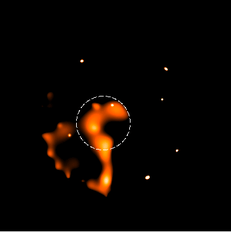
I have been focused on one peculiar source that Fermi detected. I got involved with it as soon as the XMM-Newton X-ray satellite observed the gamma ray source in the X-rays. So not only have we observed this object in the gamma rays, but we now have a new piece of information: what it looks in the X-rays (in the energy range of 0.3keV-10keV). We found diffuse, soft x-ray emission surrounding the Fermi position of the source. In fact, it looks a lot like a shock (see photo below). 

Picture

XMM-Newton data of Fermi source. Shock-like in appearance. Soft, diffuse x-ray emission present.
to After some research, my supervisor (Marco Ajello) and a postdoc (Stefano Marchesi) felt confident in the associated region: The Vela supernova remnant (SNR). 

The Vela SNR resides in the constellation Vela. It is more of a southern constellation. It probably never fully rises here in Clemson but is just southwest of the constellation Canis Major. The Vela SNR is what is left of a massive star that exploded about 11,000 years ago just 290 pc from Earth. 290 parsecs is nearly 1,000 light years or nearly 63 million astronomical units from Earth, which is 63 million times farther from us than we are from the Sun. Does that sound like a large distance? Yes? Well it’s because it is! An even more astonishing truth about this distance is that the Vela SNR is actually the closest composite SNR to Earth, making it a fascinating research tool for learning the basics about SNRs. 

Typically, a star 4 to 10 times the mass of the Sun will end its life in a massive explosion, known as a supernova. In extreme cases the star collapses in on itself to form a black hole, but in other cases, the star leaves behind a rapidly rotating neutron star. The neutron star is what is left after the core collapse of a star, the collapse creates pressures so great, the protons and electrons in the core of the star combine together to form neutrons, hence the term neutron star. The star is left rapidly rotating, as the explosion ejects large amounts of material into its surroundings, forcing the star’s angular momentum to dramatically increase. Neutron stars also have an intense magnetic field that often becomes distorted by the intensity of the star’s angular momentum, extending itself in a long beam from both poles. Charged particles leaving the surface of the neutron star travel along the magnetic field lines along the long beam as the star rotates, creating a beam of light along the magnetic field lines. As the star rotates, the beam of light shines towards Earth much the same way a lighthouse beams a light as it rotates. This creates light pulses that can be detected from Earth. In this case, neutron stars are also called pulsars for their detected light pulses. For the Vela SNR, there lies a pulsar in the center of the remnant and is pictured in the image below. 

Picture

Optical image of the Vela SNR from the Anglo-Australian Observatory’s UK Schmidt Telescope showing gorgeous detail of the supernova remnant.. The red box indicates where the pulsar sits.
The cloud like structures in this image represent the supernova explosion shell as it moves into the interstellar medium. They are optical filaments representing the front shock of the explosion as it interacts with the surrounding. Our shock is also visible in this image but we will get to that 😉

So our shock has something to do with the SNR, but which part? SNRs can be complex in structure and in their spectral properties, ranging from radio to gamma ray emission. Looking at our x-ray source in many ranges of the electromagnetic spectrum can provide several clues to its properties and maybe even its origin.  Below is an optical image from the Anglo-Australian Observatory’s UK Schmidt Telescope that shows gorgeous detail of the supernova remnant. 

This summer I have dedicated my time to researching this region, finding out the complexities of the Vela SNR and the immediate area of our shock. It has been an amazing experience getting to do astrophysics research. It’s exactly how I imagined… Absolutely breath taking and humbling! Hopefully the paper for our x-ray source will be published by Christmas time. If this intrigues you in the slightest I hope you stay tuned for all the intriguing details!