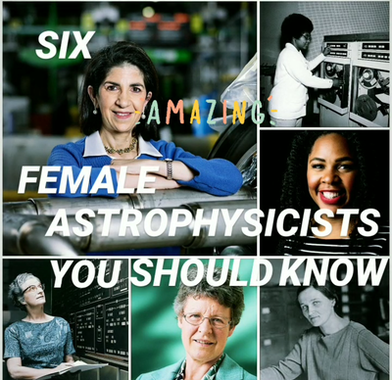
SIX AMAZING FEMALE ASTROPHYSICISTS YOU SHOULD KNOW
Start with a bang.
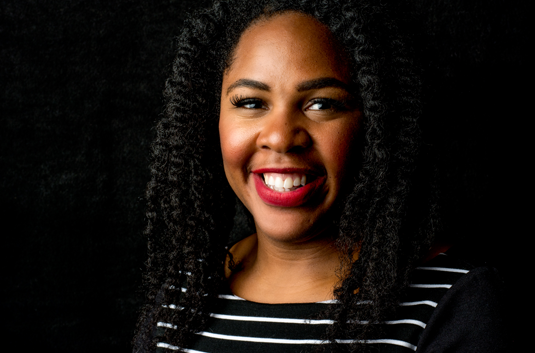
JEDIDAH ISLER

This isn’t her first appearance in this blog either. Know her name: Dr. Jedidah Isler. I didn’t know this but we are from the same area. She was born in Virginia Beach, Virginia. I was born and raised in Hampton just across the bay. Dr. Isler earned her Bachelor’s degree in physics from Norfolk State University in Virginia, received her first Maser’s at
Fisk University in Tennessee, then her second Master’s at Yale, and later her PhD from Yale, just in 2014. She is well-known and renowned in the field for her research in blazars and quasars which are supermassive black holes powering an extremely strong jet of crazy energetic particles, radiating light that is detected here on Earth and then studied by experts like her. Dr. Isler had a fairly normal life growing up, in fact it seems she was somewhat similar to me! We both grew up adoring the stars but never really knew how to get into such a specific path. Though I’ll admit she sounds like she was a way better student than I was. She genuinely was always curious and pursued valuable interests and opportunities but not without ever noticing she was the only black woman there. Because of this, Dr. Isler fought more obstacles to get to this point today,

After earning her PhD from Yale in 2014, as the first African American woman to do so in physics, she went on to be a National Science Foundation Astrophysics Postdoctoral Fellow for 3 years at Vanderbilt University while she continued her research. Today – as in right now – she works at Dartmouth College as an assistant professor of astrophysics! She is not a trailblazer yet. She is currently trailblazing – at this very moment (*ALSO she is hiring!)! I’d like to honor her strength, courage, and hard work by including her as not only an amazing female astrophysicist you should know but also as the first amazing female astrophysicist you should know.

FABIOLA GIANOTTI

Dr. Fabiola Gianotti is currently the director-general of CERN – The European Organization for Nuclear Research – based in Switzerland. The CERN facility is mainly to study particle accelerations and mechanisms with particle accelerators like the Large Hadron Collider (LHC). The CERN facility is appropriately famous for several ground breaking discoveries since beginning operation including the famous 2012 discovery of the long-sought Higgs boson particle.
CERN is seriously a display of amazing capabilities. The LHC is the world’s most powerful particle accelerator and is made of MILES long construction of magnets. It’s a big deal. And Dr. Gianotti is a big deal because she’s in charge of it. Not only that, but she is the first female to do so. She is currently serving her second term of office as the director-general. Dr. Gianotti received her PhD in experimental particle physics from the University of Milan in Italy in 1989. She has authored and co-authored over 500 publications in peer-reviewed scientific journals and has been awarded several very prestigious awards including the Medal of Honor of the Niels Bohr Institute of Copenhagen in 2013. As a woman pursuing a career in a male-dominated field, it was no easy thing to push through barriers to get to where she is today. Today, Dr. Gianotti aims to provide ample support for her colleagues, both male and female, who have children. Many women in physics struggle to maintain a successful balance between a rewarding career in physics and having a family and sometimes feel forced to choose between the two. Dr. Gianotti speaks from some personal experience and women who work in this field can surely relate (I can). Hats off to Dr. Gianotti, helping the workplace become women-friendlier!

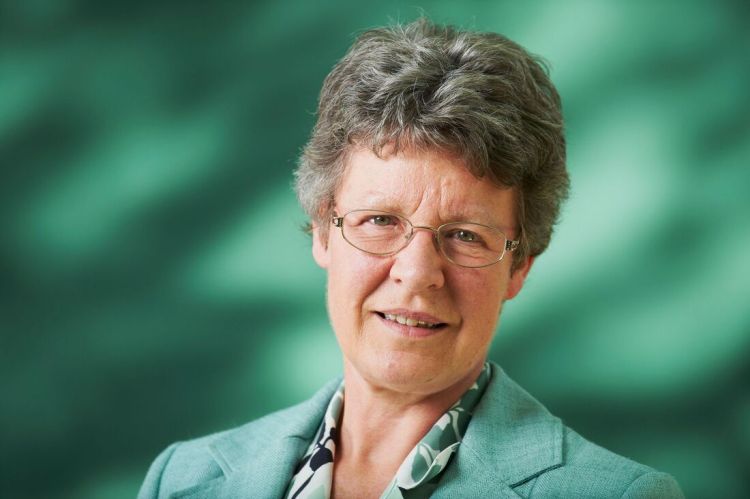
JOCELYN BELL BURNELL

Dr. Jocelyn Bell Burnell is, like, a personal hero of mine. Well, all of these women are but I have a soft spot for Jocelyn because we both got wowza’d by the same thing – pulsars. Dr. Burnell, however, was the first one ever to be wowza’d by pulsars. She was even a part of naming the darn things!
In 1967, Dr. Burnell was a PhD student at University of Cambridge in the UK when she noticed a “bit of scruff” on her chart recorder while investigating the radio sky. She was taken aback by this detection and half heartedly pursued confirming the detection, thinking it was probably nothing. Suffering from imposter syndrome, she would surely believe she made a silly error before believing she just discovered a new astrophysical object. Her graduate supervisor would end up partially believing the blip, which turned out to be extremely regular in its repetition and behavior, to be extraterrestrial intelligence. So much so, he coined the object “LGM” for little green men. Later, it was understood to be an astrophysical object and today, known as a pulsar. A furiously rotating neutron star, spewing beams of light towards Earth, like a light house; A beacon of light that you can count on seeing in a predictable way.

Dr. Burnell today is very well known for this discovery and for some small controversies around the Nobel Prize in Physics in 1974 going to her graduate supervisor for the discovery of pulsars. Although, Dr. Burnell seems to hold no resentment about it. I’ve had the opportunity to speak with Dr. Burnell and she is quite a fascinating woman who now advocates loudly for women and women with children in our field. She is a big, outspoken victim of imposter syndrome (which, for other victims, like me, greatly appreciate her bravery and wisdom). She is not only the discoverer of the beacon of light from pulsars but also is a beacon of hope for all women in the physics field.

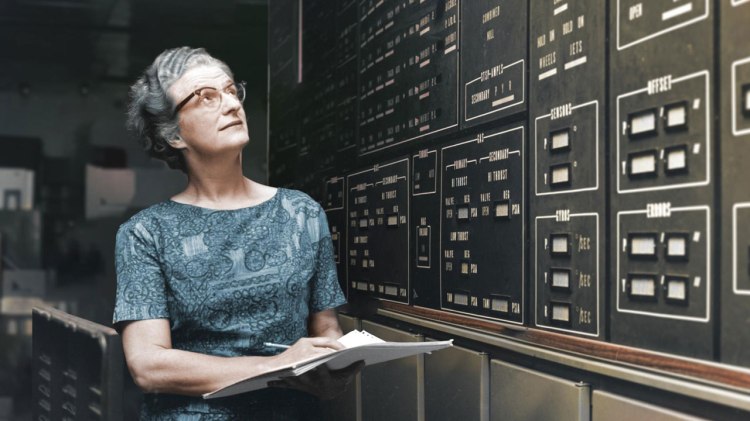
NANCY GRACE ROMAN

Nancy was a pioneer right around the same time Katherine Johnson was pioneering for black women at NASA. In the mid-1900s, NASA was not a workplace for women. Women were discouraged from studying math and science, Nancy being no exception.
Nancy recalls her mother showing her constellations in the night sky, grabbing her attention. She decided very young that becoming an astronomer was the path for her. In 1949, Dr. Roman earned her PhD from the University of Chicago. In 1959, she began work at NASA, where she became the first chief of astronomy in the Office of Space Science. She was also the first woman to hold an executive position at the space agency. Dr. Roman was called the mother of Hubble, the optical space telescope that was launched in 1990 and is still operating today, 30 years later. She was a program scientist who was basically the person who would convince people the mission was worth doing, as she puts it. Dr. Roman had a lot to do with how the telescope was designed and built and kept up appeal and interest from investors.

​On May 20, 2020, NASA announced it will name the next-generation space telescope after Dr. Roman. The Wide Field Infrared Survey Telescope (WFIRST) is currently under development and is set to launch in the mid-2020s. The new name of the telescope is now The Nancy Grace Roman Space Telescope. It will investigate open questions in astrophysics and cosmology such as the force behind the universe’s expansion and to search for distant planets beyond our solar system. NASA rejoices Dr. Roman’s efforts, describing her as ‘tirelessly advocating for new tools that would allow scientists to study the broader universe from space’. This is also in memory of Dr. Roman, who passed away in 2018 at the age of 93.

CECILIA PAYNE- GAPOSCHKIN

Cecilia is one of the women known as the Harvard Computers, which consisted of a number of women working as skilled astronomers, collecting and processing optical data at the Harvard Observatory in the late-1800s onwards. Cecilia was among Williamina Fleming, Annie Jump Cannon, and Henrietta Leavitt and others, who tirelessly studied light from stars. Studying stellar spectra, the Harvard computers made several major contributions to astronomy, including the famous stellar
classification system – Oh, Be A Fine Girl, Kiss Me! or OBAFGKM, which types the varying stars based on their optical spectra. ​​Cecilia, in particular, made a pretty big discovery herself, which she and her PhD thesis advisor squabbled over for years. Henry Norris Russell was one of the astronomers who developed the Hertzsprung-Russell Diagram, a fundamental graph displaying stellar evolution still used widely today. Russell was sure Cecelia’s work must be wrong.

In 1925, Cecelia submitted her PhD thesis, which was comprised of extensive analysis of a huge dataset of stellar spectra, all showing enormous abundances of hydrogen and helium, a surprising result at the time. Today, it is understood that hydrogen and helium are the most abundant elements in the universe. In the Milky Way alone, it is estimated the baryonic mass is roughly 74% hydrogen, 24% helium, and all else being remaining heavier elements. In 1925, however, it was still thought that stars were made up of similar composition as the planets, like Earth. There was no reason to believe otherwise until, alas, abundant evidence shows us that indeed, the universe is made up of mostly the two lightest elements. Her discovery profoundly changed our outlook on the universe, stellar evolution, cosmology, and more. By 1956, Cecelia had accomplished becoming the first female professor at Harvard and the first woman to become department chair. She passed away in Cambridge, Massachusetts in 1979.

JEANETTE SCISSUM​

So technically, Jeanette was a mathematician but I’ve included her as an astrophysicist because she is well-known for her contributions to knowledge on the Sun’s sunspot cycle. Jeanette was the first African-American mathematician to be employed at the NASA’s Marshall Space Flight Center, based in Huntsville, Alabama in 1964. Jeanette grew up in Alabama when segregation and other racial discriminatory laws and behaviors were normalized.
She went to an all-black school and graduated from high school in 1956. She went on to receive her Bachelor’s and Master’s from Alabama A&M University. Her 1967 report, Survey of Solar Cycle Prediction Models, provided new methods for improving predictions of the solar sunspot cycle. She went back to school some time later to earn her PhD in computer science and went to work at the Goddard Space Flight Center in Maryland. She worked as a computer systems analyst responsible for analyzing and directing NASA systems. During her career, she remained passionate about inclusion and equity. She volunteered as an equal employment opportunity officer in her spare time. Jeanette retired in 2005 and in 2017, NASA honored Jeanette for her skill, perseverance, and positive attitude as part of the first Alabama Historically Black Colleges and Universities Roundtable Discussion.

​Six extraordinary women of science and their stories

We acknowledge these women fought various obstacles in the workplace from historical and systematic oppression of their gender and for some, they were discriminated against for their race as well. We applaud these women for their courage, knowledge, and wit that it took for them to accomplish their goals in spite of added difficulty.

PART VII: SENIOR YEAR

Writing these posts always brings me back… Senior year, my last year at Radford University. I was knee deep in physics coursework, running with Ruca by the New River, shenanigans on Downey Street on Darkside, and also in a blindingly toxic relationship.


Fall of my senior year I took an astronomy course, some general chemistry, Spanish, and … Goodness it’s been four years almost! I can’ t remember! I want to say it was electromagnetic theory I. I know in the Spring of my senior year I took quantum mechanics, Spanish, and the Arctic Geophysics course again. Honestly, it was a year where I was not very academically inclined, at least compared to years past. I don’t regret that though. I was fully aware it was my last year in college and I intended to enjoy a little more of the “college experience” before leaving. I was also a little distracted by my then-boyfriend (things did NOT end well, lol). But hey, it was a ton of fun. I made lots of good memories and friends. When I moved out of Radford, I was a sad girl for a long time. I was really excited for the next chapter of my life but, looking back, that was the first time baby Jordan really made a home for herself in a new place and now she was leaving it. 

And sure, when I moved home for the summer I was freshly (and not happy about it) single and things seemed really uncertain, even though at this point I had accepted Clemson University’s offer for their PhD program. It wasn’t until I actually moved to Clemson that I began to feel excited about my new life (though it still took a long time to adjust and to feel like Clemson was a new home, ya know).
Picture
Me decorating my graduation cap, the morning of my college graduation. May 2016.
The fall of my senior year is also when I “prepared” and took the graduate record examinations (GREs). For some subjects, you have to take both the general and the subject, where for me, the subject was physics. The GRE is basically the SAT of graduate school. It’s the usual standardized test that unnecessarily takes up your time and money. I did not do great (at all, not even a little bit) on the physics GRE. 


Like, I did really bad. I barely studied. Mainly because I didn’t want to in my free time. I mean, I’m in the middle of a full time semester. Why would I want to study for a test I just signed up for? Other than that it cost $500.00 to do so? Lol. That and I found out later that I had a small exposure to physics, even with a Bachelor’s degree from a small school. When I started at Clemson, I had to take some classes I was missing before entering the PhD program. I was really intimidated by that realization but I’ve since come a long way.

Picture
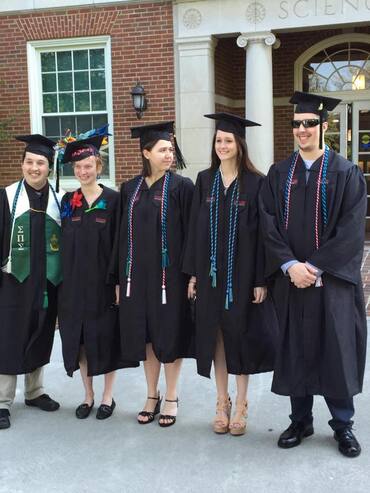
I am fourth from the left. May 2016 college graduation with some of my physics peers.


People always use this analogy on how to be successful life: Imagine you live your life day by day, with little planning. It’s like trying to balance a ruler on your fingertip but only focusing on the base of the ruler. The ruler falls every time. If you look at the entire ruler, however, you find that you can easily balance it. I always felt like I lived life by just focusing on the base of the ruler. Honestly, I still do. And it seems to work out pretty okay for me. I stumbled into graduate school much how I stumbled into college. Though I really stumbled into it this time.

Jordan, are you applying for graduate school? Are you taking the GRE? I just got into blank blank!! I just got an amazing job offer after I graduate!

​I sat down and asked myself what I wanted to do. Apply for career positions or apply for graduate school? After pondering it for about thirty minutes, I decided I like the dynamic of a school schedule. That was all it took for me to commit to applying to graduate school. Cue the GRE “preparation” and performance. I devised a list of graduate schools and kept track of statistics I found important. For instance, I wrote down how many applicants they received versus how many they enrolled, how many female students they had, what was the faculty to student ratio (i.e. would your thesis advisor be stretched thin with students? What if you’re like me and need your advisor to sometimes hold your hand through tasks?), and what their stipends were for teaching and/or research. I applied to 8 or 9 schools. Let’s see if I can remember them all.

I applied to University of Maryland in Baltimore, Clemson University, College of William and Mary, University of Virginia, University of North Carolina, Chapel Hill, Wake Forest University, University of South Carolina, North Carolina State University in Rayleigh, and Colorado University in Boulder (Woo! I got all 9). I spent – ahem, my parents​ spent – around ~$2,000 just applying to graduate schools. That includes the cost of taking both GREs (the general and the subject), fees to send the GRE results to select schools, and graduate school application fees. Guess how many I got into?

Guess.

​Just guess.

Picture
Guess.


One.


I got one acceptance.

To Clemson University. And it wasn’t even formal. It was a hey, we have one or two more spots left for teaching assistants. Whoever responds first gets dibs! And you best believe I had that acceptance letter signed and sent that very same moment. At that point in time, I had just barely made it into graduate school. I just weaseled my way right in. Clemson simply needed more staff for their high demand in physics labs and I hopped right on that PhD train (and that is part of the reason why imposter syndrome has developed so strongly with me XD). 

No hard feelings though. I took what I could get and I feel like Clemson is really glad to have me (and vice versa). But, when I got the offer from Clemson, I was like who? 

​Where even is Clemson? I asked myself. Quick Google search showed it was still in the Appalachia, where Radford is, just farther south in South Carolina. I thought, okay cool so similar surroundings; rural and mountainous. Sign me up! And that was that. I barely registered what Clemson University was all about. Didn’t register during applying – only mattered when I realized that that is where I was going to live for the next however-many-years-it-takes-to-get-my-PhD. 

Picture
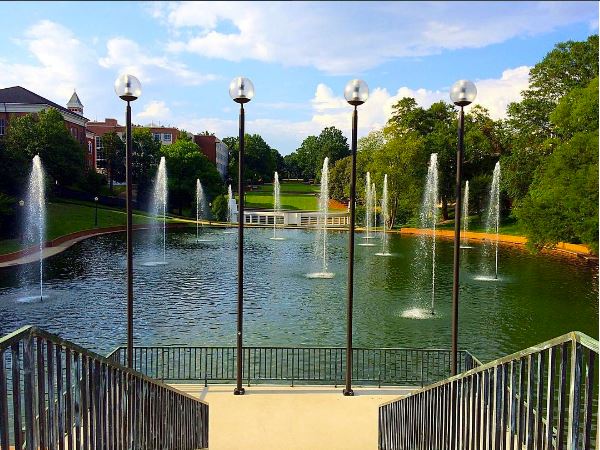
The heart of Clemson University.
 
In short, I basically live my life as a sequence of on-a-whim, off-the-cusp decisions and opportunities. So far it has been a decent method for me.

Clemson did indeed turn out to be the perfect mixture of rural and development that I needed. Clemson is a huge University (from where I was coming from) and a way bigger town than Radford but still small and rural just outside of campus. It is a beautiful town and area, as is much of the Appalachia in my opinion. 

And even though I didn’t feel very lucky at the time, the break up I had before graduating ended up being a really good thing for me because that first year into the PhD program at Clemson was hard!  I am thankful and grateful, looking back, that I had Ruca and little distractions. I was able to focus on physics and get where I needed to be to pass exams and pursue my PhD. Ruca kept me sane. I didn’t do much socializing or integrating into the community my first year there. I felt a little alone. It was a new place with new faces plus I was really busy with school work. That first year, I spent a lot of time exploring the area with Ruca. 

Picture
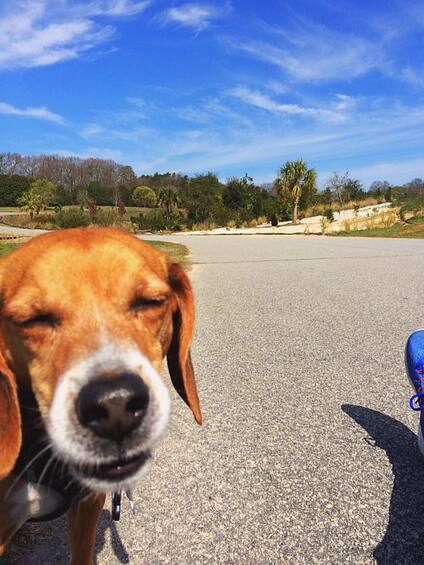
Ruca and I discovered South Carolina Botanical Gardens on Clemson’s campus. It is one of my favorite places to be! This was taken in March 2017, the spring semester of my first year at Clemson.
 
Let’s recap briefly.


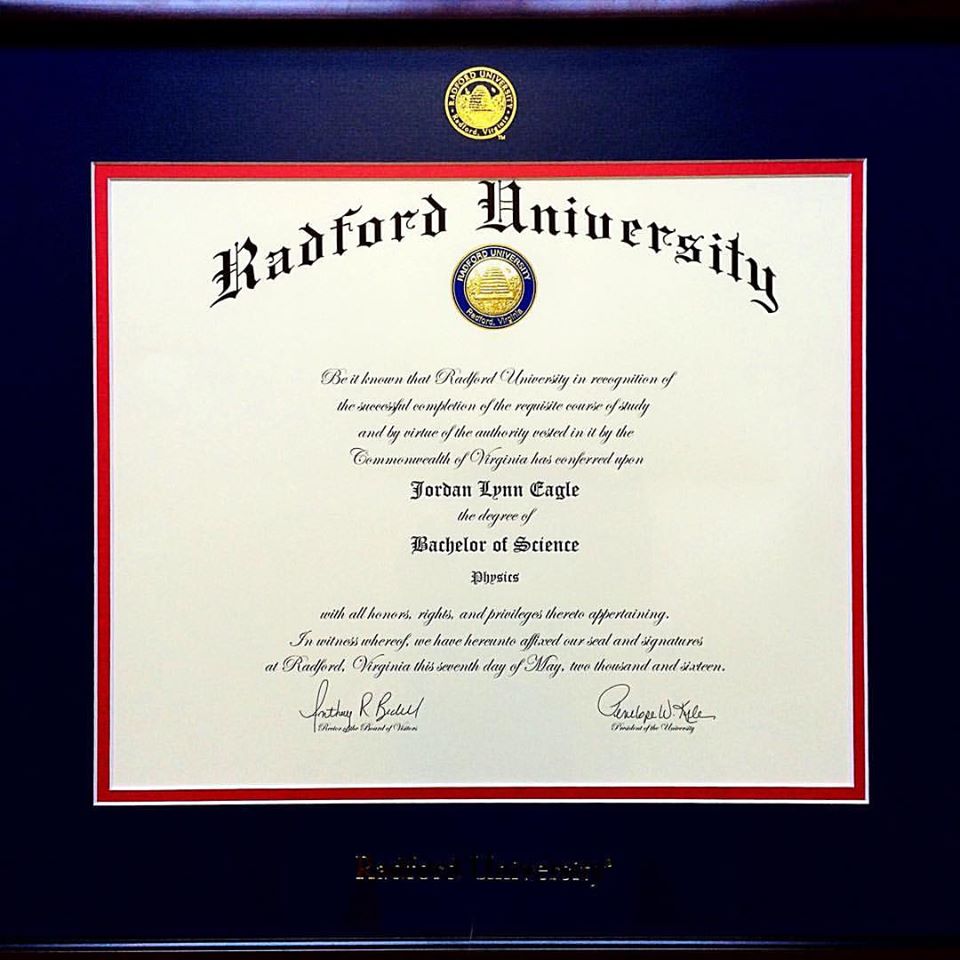
I was a mediocre student my last year of college. I got a C in quantum (but I definitely deserved a D). I was distracted by a boy I really liked but our relationship was really toxic and ultimately distracted me and made me be less academically successful than my previous college years. But, I still had a great time, enjoying all the non-academic activities that college often brings and it was hard to say goodbye to Radford when it was time. I stumbled into graduate school on a whim with little thought though lots of time and money were spent into applying. I only got one offer which I accepted. I later graduated college in May of 2016 with my Bachelor’s in physics and was anticipating beginning the PhD program at Clemson University. In August of 2016 I moved to Clemson, South Carolina – not knowing a soul down there. It was just me and Ruca for that first year and I wouldn’t trade that for the world.

So far, the cliche “Nobody ever said it would be easy, they just said it would be worth it” is, like, totally true for me.