I realized special things can happen when I apply myself.
So, I failed my first physics exam in college but, that didn’t stop me. I started spending hours per day studying, preparing for my next exam, determined to get an A. I started spending my weekends studying as well which was the beginning of losing my weekends forever (yay). My second exam came and went: 83 (B). My third exam came and went: 87 (B) – I believe was the grade. Then, the final. 95 (A). I got a B in the course with the highest score on the final exam and that’s when I decided I wasn’t going to look back.
I realized that with some effort I can actually do something special, no matter how hard it was. This is also right around the time when I started opening my eyes to other opportunities around me like scholarships, special physics courses or else that involved studying abroad, joining the Society of Physics Students (SPS), getting involved in the physics department as a work study student (paid!), and more. I slowly started becoming known in my department and in the college of science and technology (CSAT at Radford). That’s when I just happened to hear about the Arctic Geophysics course that you have to apply to in order to take the class and earn credit – that takes you to ALASKA to do REAL, hands-on research! At this same time I had heard about the physics department scholarship which would be useful if I ended up getting into the course. I don’t remember what I was doing exactly but I remember interrupting something with my work study to run to the computer lab to quickly apply for both the geophysics course and the scholarship. I spent maybe an hour in total doing this. I thought, there’s no way I’ll get either of these things but at least I can say I tried. What do ya know? A month later during that fall semester of my sophomore year, I got an e-mail congratulating me on being accepted into the Arctic Geophysics course but also outlining the thousands of dollars it took to take the course in totality.
For now, I skipped over the cost and called my dad and said DAD! YOU’LL NEVER GUESS WHAT I JUST GOT INTO! I’M GOING TO ALASKA! I remember the pride I felt and the pride I think my dad felt. I think I briefly said something like, it’s a lot of money though, and my dad saying, we will work it out.
I quickly and eagerly accepted to be in the course and then began the process of preparing to spend my sophomore year spring break in Barrow, Alaska, the northernmost city of the United States.
This was taken on my third trip to Barrow, Alaska. Taken approximately a quarter mile from the shore on the Arctic sea ice by our fabulous photographer. You can see the “Ice Walkers” (us) as the locals called us.
You see, I knew I chose physics so that I could get closer to the stars and sure, this geophysics course wasn’t exactly in my field of interest but, it’s hand on research experience. That is invaluable in any field and I mean, you get to go to Alaska. Who wouldn’t want to go there?
The Arctic geophysics course at Radford is offered every other year on the even years. I attended in 2014 and again in 2016 for ice research (but also travelled there in 2015 to perform unrelated bird research). It is a pretty intense course. You spend January, February, and half of March preparing for the 1-2 weeks the team spends in Barrow, Alaska in mid-March. This includes practicing with the equipment on campus, learning the theory behind the equipment, developing writing skills to log the research adequately, familiarizing ourselves with the data reduction software (RES2DINV), and preparing ourselves for the ICE COLD.
If I’m not mistaken, we even spent Saturday mornings preparing for much of the spring semester leading up to spring break. As I mentioned before, it also took a lot of money. I remember my family cashed out the government savings bonds that was gifted at my birth to pay for just lodging. I also remember the plane ticket alone being about $1,100.00. Then there is food when you get there, warm clothes (thankfully parkas, ice boots, and very warm carharts were provided), and the actual cost of the course (included in the tuition bill for spring semester). It is no easy thing to prepare for with prices like that! It did help that I was awarded the Fall 2014 scholarship from the physics department – about $450 I think it was. Nowadays, I do believe there is more funding in place for this same course at Radford but, it could still be better so that anyone can consider doing something like this (regardless of income status)! I know the person running the course, who became a close mentor of mine in my undergraduate career, is dedicated to making this happen.
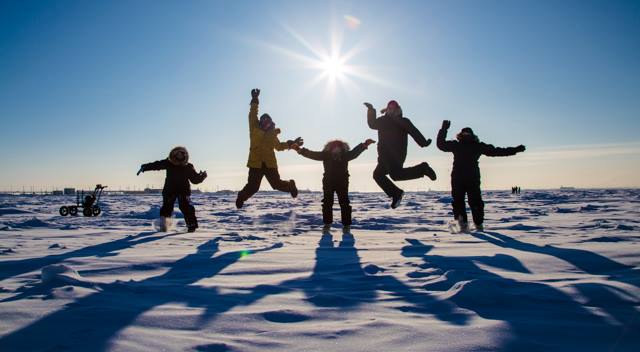
Part of the research team, taking a break, at the 2014 trip to Barrow. I think I’m the weirdo that is still on the ground, mid-jump.
Let me remind you: I had no research experience of any kind and had ONE physics course (introductory physics at that) under my belt. I still have the original e-mail of my offer to the course and Dr. Rhett Herman, the instructor of the course, wrote, “I really love seeing when beginner students apply for opportunities like this, regardless of experience. Congrats!”
My second college spring break was indeed spent in the frigid, subzero temperatures of the Arctic circle in Barrow, Alaska. I spent nearly all day out on the ice, collecting data, and taking it all in that I was here. In Alaska. A half mile away from the shore, standing on what we later confirmed was about 2 meters of ice with a bear guard always on watch, surveying the ice beyond the ice ridge that protruded above the surface of the ice a couple hundred meters farther out. At night we reduced the data we had taken during the day on the ice. Some days it was too cold (colder than -45 degrees Fahrenheit or -42 degrees centigrade) to do any research and those were the days we took the time to venture out into town and speak with the Natives there. We immersed ourselves in the Utqiagvik culture and the Iñupiat heritage, attending the local museum, buying authentic homemade art engraved on baleen, learning their ancient dances and rituals, and trying whale blubber, a local town delicacy. It was more than a research experience as you might have guessed. It was truly a turning point for me in recognizing what is possible not just for my career but in what experiences the world has to offer.
We employed several different ways to measure the ice thickness, the most straight forward one being to drill straight into the ice. In Barrow, Alaska, this is no easy task. The drill batteries in subzero temperatures had a very limited lifespan (without hand warmers, less than five minutes with a full charge) and we are too far from shore to simply connect to a constant power supply. Picture here is Jesse and Sarah, two research students on the first (2014) trip to Barrow.
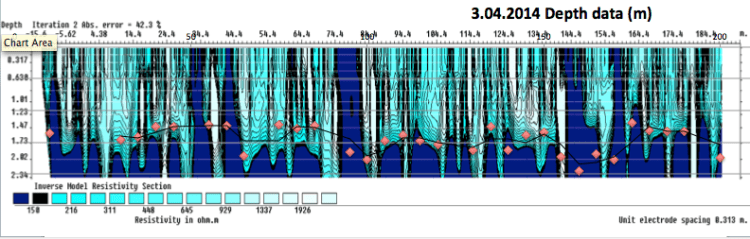
A sample of the results from the 2014 trip. The contour plot shows you the ice thickness, where you can see the ice is no thicker than about 2 meters. This was imaged using the OhmMapper resistivity array. Basically it measures the difference in resistivity of materials and this can tell you what material (water or ice) you are looking at. One of the big issues we found with this array is the signal would get lost once it passed the ice-water boundary. Water has very low resistivity, and therefore the signal easily escapes into the water, never making its way back to the receiver to be measured. The red dots indicate surface temperatures measured from the ice surface. We were looking to establish a correlation between the surface temperature and the thickness of the ice. If there is one, you’d easily be able to measure ice thickness and evolution over large areas!
Towards the end of the spring semester of my second year in college, I heard about ERIRA: Educational Research in Radio Astronomy, held for one week at the Green Bank Telescopes in West Virginia (where the world’s largest directional radio telescope sits!). Once again I applied on a whim, knowing that it was a nationwide program that accepted less than 20 students per year.
The summer of 2014, I went to Green Bank, West Virginia to use radio telescopes and learn firsthand radio astronomy from leading scientists.
Ah, right. The new gamma-ray emission on the west of the Vela supernova remnant. After retrieving all of the known data available to us about this region, we started to piece together the puzzle. Here’s what we know!
1. New gamma-ray emission is uncovered directly to the West of the Vela SNR.
2. The gamma-ray emission is very high in energy, that is, all of the energy is detected above 50GeV.
But that’s it. We don’t know why gamma-rays are emitting at this one small section of the remnant. We don’t know what event occurred for this to happen. We don’t know what particles are responsible for the emission. Instead, we used this information and what it implies to make the next step: submit a proposal to view the region in X-rays. X-rays are also pretty high in energy but what makes this wavelength regime appealing to us is that present telescopes that can image in the X-ray have spectacular angular resolution compared to gamma-ray telescopes right now, i.e. we can see more features and distinguish between sources easier in the X-ray than in the gamma-ray. For example, the XMM-Newton X-ray space telescope has an angular resolution on the order or arcseconds. This is 1/3600 of one degree. In comparison, a full moon is roughly 1/2 a degree in our sky so 1 arcsecond of the moon would be 1.388×10^(-4) (or 1/7200) of the Moon we see which is a really tiny, tiny, tiny part of the moon. We would not be able to resolve 1 arcsecond with our own eyes. Nor would we be able to resolve 1 arcminute (which is 1/60 of a degree or 1/120 of the full Moon) with our own eyes. The Fermi-LAT, on the other hand, can resolve very high energy (VHE) sources on the order of arcminutes. So, the angular resolution in the X-ray regime is much more attractive in our endeavor to try to find more information about this new gamma-ray source.
Furthermore, the X-ray sky is somewhat less crowded. The gamma-ray sky has a lot of diffuse, or spread out, emission across the sky. A lot of this comes from our Galaxy as well as extragalactic sources (sources that are not in this Galaxy) and this can be especially distracting near the Galactic plane (see image below). We now know that the entire gamma-ray sky is full of gamma-ray emission coming from all over the Universe! The X-ray sky also has a diffuse background but it is a little easier to work with.
The gamma-ray sky at energies from 50GeV and up to 2TeV as seen with Fermi. This was first reported in Ackermann et al. 2016; the 2FHL catalog. Our source of interest in indicated by the magenta circle. The center of the image shows you the Galactic center with the Galactic Bulge dimly visible in gamma-ray emission. There are “Fermi bubbles” or arms reaching out from either side of the center. The long line of gamma-ray emission shows you our Galactic plane, where nearly all of our Galaxy sits. The rest of the emission is coming largely from extragalactic objects.
So for this reason, we asked for time on the XMM-Newton X-ray space telescope to observe our peculiar source and we got it! After cleaning the data we received from the telescope, we were able to study the X-ray emission that exists at the same location in space as the gamma-ray emission we see. We indeed found an X-ray counterpart which is a compelling overlap in both shape and position for the X-ray and gamma-ray emission. The other nice thing about looking in other wavelengths, if you can find one positive counterpart, you can then use this new information to look further into other wavelengths to see what other emission this region might be giving off. That’s exactly what we did! The images below reveal the X-ray emission we see after cleaning up the data and the first counterpart we found by using the position of our gamma- and X-ray data and the shape we resolved with XMM-Newton.
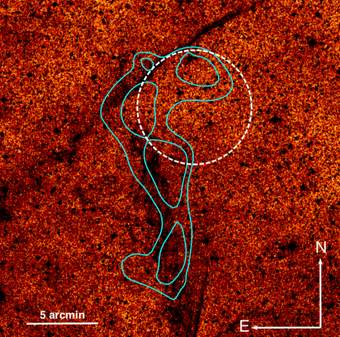
This is the X-ray emission we see with XMM-Newton coming from the 2FHL position. The circle is 5 arcminutes in radius and denotes where the gamma-ray emission is observed. We used this odd shape of X-ray emission to try to find other counterparts.
This is an optical image, specifically looking at the Hydrogen (-alpha) emission at 656 nm. You see a filament, or very thin structure, that traces the X-ray emission we see, with the 2FHL position again indicated by the white circle.
A picture is starting to form in our minds… We have gamma-ray emission that is very concentrated to the west of the Vela supernova remnant that has soft, or low-energy, X-rays tracing out an optical boundary or filament. Something must be happening at the edge of the remnant here for it to be so energetic with so many puzzle pieces. We started leaning towards the idea that maybe the remnant is running into something here and is shocking it. Imagine a hot, really fast-moving wave of heavy mass hitting a cold, slow clump of gas. A lot of mixture, turbulence, and violent disruption happens on many scales. You would expect the cold, slow clump of gas to ignite in some way; the gas particles responding rapidly and enthusiastically with its new momentum from the collision, colliding into each other and gaining massive amounts of energy at the collision boundary. It begins to illuminate its surroundings as these interactions take place, heating the gas and shocking it further. The gas clump likely feels an incredible increase in its temperature.
It seems reasonable then that this is in fact what we are seeing but we cannot say for sure. If this work will be worthy to publish, we need concrete evidence that a shock-cloud interaction is taking place and causing the emission we see. So, we keep digging for more puzzle pieces.




 JORDAN L. EAGLE