March 7, 2016: Dude, where’s my ice?

I arrived to Barrow, AK on March 5. It was a long plane ride. My life feels like it’s just awkward sleeping positions on planes. But it was worth it!

I got here before noon with Abdullah. Flying in over the Chukchi Sea, I see a lot of water which made me freak. As we approached the shore overhead I could see that – yes – there was ice, though barely. I could tell even from the plane that the ice was not nearly as far out from shore as it was even just a few years ago. Natives recall the ice stretching out as far as 10-12 miles in years past, and decades ago it reached farther than that. It was maybe a kilometer in some areas (less than a mile). Often wind will come in and break off pieces  of the ice during the season which I’ve heard happened not long before our research team arrived in late February. 

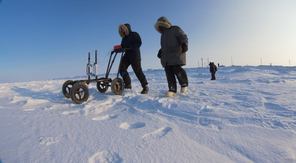
After retrieving our ice permits the first thing we did was go out on the ice! No equipment on Sunday because the wind chill was crucial, too crucial for the equipment, and even a little crucial for us – but we couldn’t stay away. We didn’t walk out far on the ice because of this. Other than the 25mph winds slapping our faces it was a beautiful day. The sky was blue, the sun was up, and ice as far as we could see. You could see out on the horizon a smokey haze just above the ice – that was water vapor. Yep, water vapor from the ocean. Because the ocean was so near to shore this year to the point where we could see the steam coming up from the surface. No bueno. 

Last week’s crew got some good data to give us an idea of what we’re working with. In 2014, the average ice thickness was about 1.2-1.8meters. That was considered thin then, too. This year, the ice has been measured to be about .90meters. .90meters. Need I say it again? 90cm. THAT’S ALMOST HALF IN SOME PLACES. It’s not thin enough to be dangerous to walk on, but it has various negative impacts on the surrounding environment. The lack of ice that stretches out from shore causes the whales to be closer to the shore. Some may think this is good news for whaling season. However, the thinness of the ice makes it too dangerous to set up camp near the open water. This lack of ice also increases the amount of Polar Bear sightings around town which is dangerous for the townspeople and is also an implication that the hunting land (ice) for the bears is inefficient. 

It has been rather windy since I have been here. Up to a -40F wind chill. I am hoping to be able to get at least the sensor sleds out on the ice today to do a few test runs. We brought the OhmMapper, a ground penetrating radar (GPR), and three homemade sensor sleds. Three of the sleds are taking infrared (IR) temperature data including surface temperature and ambient air temperature. One of the sleds has a platform with 6 or 7 Dallas Semiconductor temperature sensors to monitor any temperature gradient from the surface of the ice up to about 1.5 meters up. So far no such temperature gradient has been detected. 

If we can at least confirm that the sleds are working properly, we can get out there with all of the equipment, ready to go, on the days that won’t be too cold. Hopefully the wind will die down by Wednesday. Stay tuned!
Preparation for AK

The last few weeks have been preparing the new Arctic Geophysics research team to deploy various pieces of equipment to survey the subsurface of the ice. So far we have covered polar properties of the ice and what to expect the thickness to be upon arrival as well as doing small sample exercises of calculating power that the seawater radiates through the ice up to the surface. These are all important key factors in understanding how the ice changes over time and thus, the shape it forms underneath. 

We have given the team members insight as to how the equipment will work by doing sample surveys on campus to get them a feel of working the instruments including the OhmMapper, a capacitively coupled resistivity array, a ground penetrating radar (GPR), and a homemade instrument designed to gather surface temperature data along with ambient air temperature, and the microclimate temperature variations to about a meter above the surface of the ice. All of these instruments will collect data using different methods in order to give us the best picture of the subsurface of the ice. In order to verify our results, we will be drilling into the ice, aka ground truthing. This will enable us to compare ground truthing data with OhmMapper and GPR data to confirm its accuracy and to throw out discrepancies in the data. For instance, the modeling software used often times has a hard time transitioning between the huge jump in resistivity of the ice and seawater. This can create blips or artifacts in the mapping of the ice that we know are inaccurate. Sometimes, we might see what looks like water on the surface and that is something that is not encountered so we know this cannot be accurate data. We also know a decent average of the thickness so when a piece of ice goes off the map, suggesting a 2-3 meter chunk of ice, this is also something that is likely an anomaly and can be disregarded after comparing to ground truthing data.

We have one more session to familiarize ourselves with data collection and processing before heading to the Arctic. My hopes on this trip are that the team this year be as motivated and dedicated as they were in 2014, and can receive the biggest, best data base yet. I’m excited to see which of my peers will step up and get the most out of the research trip and to see our findings being presented as a whole at the end of the semester at the Student Engagement Forum. 

Picture

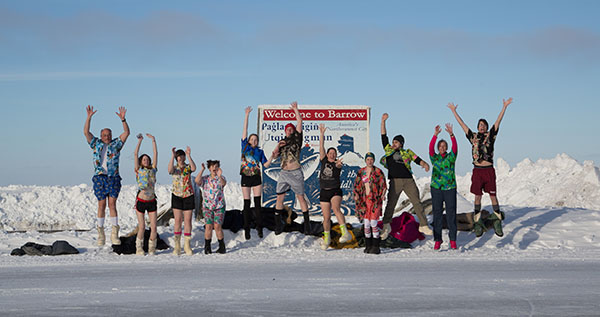
The 2014 research crew in tacky Hawaiian shirts in the Arctic. Good times!

Arctic Geophysics Field Research Overview

Radford University’s professor of physics, Dr. Herman, is the instructor and coordinator of the Arctic Geophysics Field Research course. The course is an intensive ongoing research project that enables students to get real, hands on, onsite research in Barrow, Alaska. The mission is to establish whether or not a correlation between the surface temperature of Arctic Sea Ice and its thickness exists. We do this in a number of ways using a capacitively coupled resistivity array known as an OhmMapper along with electronics drills for ground truthing OhmMapper findings, and working with Arduino-based thermal sensors that collect data of the temperature of the surface and surrounding air. 

I first participated in the course as a student in Spring 2014 which was also the beginning of my research experience. I have had the opportunity to continue working in Alaska on two projects ever since. I built and deployed equipment to study the Arctic microclimate and its affect on bird nesting locations involving Arduino-based sensors recording data such as wind speed, temperature, and humidity. This research project had multidisciplinary qualities and the instruments designed gave us a new approach to the Arctic Geophysics course. How might the microclimate affect the properties of the ice? Along with continuing the research that suggests a possible correlation that can lead to better methods of studying large areas of ice. 

In Spring 2016, we will be traveling back to Barrow to grow our database as well as harness new information that may help us. It will be a pleasure to return to Barrow and be able to step hundreds of meters out onto the Arctic sea ice and close out my physics career at Radford the same way it started: studying ice!

Picture

Jesse Dodson (’14), and Sarah House (’16), drilling through the ice with an electronic drill and 2-m drill bit. Ground truthing data for the OhmMapper. (From spring 2014 trip)
Picture

Corey Roadcap (’14), and Professor Rhett Herman surveying a section of the ice with Whistler, an Arduino-based thermal sensor designed by Dan Blake. (From spring 2014 trip)